
What is a cervical screening test and how does it work?
Cervical screening (sometimes called a smear test) helps prevent cervical cancer from developing, it is not a test to diagnose cervical cancer.
When you attend your cervical screening, the doctor or nurse will take a sample of cells from your cervix. They will do this by inserting a speculum into the vagina and sweeping the cervix with a soft plastic brush. Your sample will be sent off for testing.
They will be looking to see if you have high-risk HPV, the common virus which causes nearly all cervical cancers, and if you do, your sample will be checked for any changes to the cells which could potentially lead to cervical cancer in the future.
HPV is passed on through skin-to-skin sexual contact. 8 in 10 of us will come into contact with it at some point during our lives. Usually, the immune system clears it before it causes any problems. If it isn’t cleared and any changes do develop in your cervical cells, they will be graded into either cervical intraepithelial neoplasia low grade (called CIN1), medium grade (CIN2) or high grade (CIN3).
We have an Easy Read guide on cervical screening, which you can download here.
When am I due to go for my first cervical screening test?
Cervical screening starts at the age of 25 in the UK. Around your 25th birthday you will receive a letter inviting you to book your first screening. You can then contact your GP surgery to book your appointment.
You will be sent a letter to invite you for your screening every three to five years until the age of 50 (depending where you live in the UK), and then every five years until the age of 64. If you have high-risk HPV or any cervical cell changes picked up, you will be checked more regularly.
If you’re trans and registered as male at your GP surgery you may not receive a postal invite, but if you have a cervix you are eligible for screening and can book in by calling your GP surgery.
How do I book my cervical screening?
When your cervical screening is due, you will be sent a letter which tells you where you can go for your screening and how to book an appointment. These letters usually arrive about 6 weeks before your screening is due. You can only book an appointment when you have received your letter.
What if I missed my cervical screening?
You can still book an appointment if your screening is overdue, contact your GP surgery or local sexual health clinic.
Can I get my cervical screening results from Ask Eve?
No. Ask Eve is run by The Eve Appeal which is independent of the NHS Cervical Screening Programme. You can contact your GP or the clinic where you had your test if you have any questions about when you will receive your results.
Will the cervical screening test hurt?
Some people find cervical screening uncomfortable, but it shouldn’t be painful. If you have a medical condition that might cause you pain whilst having your cervical screening, such as endometriosis, vaginal dryness, vaginismus or you are post-menopausal, do talk to your GP and share your worries as there are a few steps they can take to help make you feel as comfortable as possible, such as using a smaller speculum.
I have had the HPV vaccine, do I need my screening test?
Yes. The current HPV vaccine protects against 9 strains of HPV: types 6, 11, 16, 18, 31, 33, 45, 52 and 58. Strands 16 and 18 cause around 70% of all cervical cancers. There are 5 other strains of high-risk HPV (HPV that can cause precancerous cell changes) that are not currently in the vaccination. Over 99% of all cervical cancers are caused by HPV but there are a small number that are not.
If you’ve been vaccinated it is still important to go for your screening test to pick up on any cell changes to your cervix. Together, vaccination and screening prevents thousands of cases of cervical cancer a year, so it is important to have both if you’re eligible.
I am on my period, can I still go for my screening test?
It is best to try and book your cervical screening appointment for when you will not be on your period. If you are on your period when your test is due, do get in touch with your GP surgery and change the appointment.
I’m trans. Do I need to go for a cervical screening test?
If you have a cervix, you will still be at risk of cervical cancer and do need to get screened if you can. If you have any worries or concerns about going for your screening, do speak to your GP or our Ask Eve nurse service.
I am a woman who has only had sex with women, do I need a cervical screening test?
Yes you do. Unlike other STI’s, HPV is transmitted by skin-to-skin contact and can be anywhere, including your fingers and mouth. You can get HPV from just one sexual experience, and do not need to have had penetrative sex.
I have had a gynaecological cancer (not cervical) in the past, do I need to be screened?
If you still have a cervix, then you will need cervical screening. Your GP or cancer specialist will be able to talk to you more about this.
I am asexual. Do I need to go for a cervical screening test?
Everyone with a cervix should go for a cervical screening test if they are able to regardless of their sexual orientation and sexual history. HPV is a common virus that over 8 in 10 people will have over their lifetimes and is transmitted through skin-to-skin sexual contact, which includes any touching of the genitals, oral, vaginal and anal sex as well as sharing sex toys. So, if you have had any form of sexual contact, you may have been exposed to HPV and could be at risk of cell changes or cervical cancer developing. If you have never had any type of sexual contact then you are at a lower risk of cervical cancer, but as a small number of cervical cancers are not caused by HPV, it is important to still go for your screening test.
I haven’t had sex. Do I need to go for my screening test?
If you have never had sex, it is not a guarantee that you do not have any cervical cell changes. You can get HPV from any form of sexual contact, and do not need to have had penetrative sex. If you have never had any type of sexual contact then you are at a lower risk of cervical cancer, but as a small number of cervical cancers are not caused by HPV, it is important to still go for your screening test.
I am worried screening will be difficult for me as I am a survivor of sexual trauma.
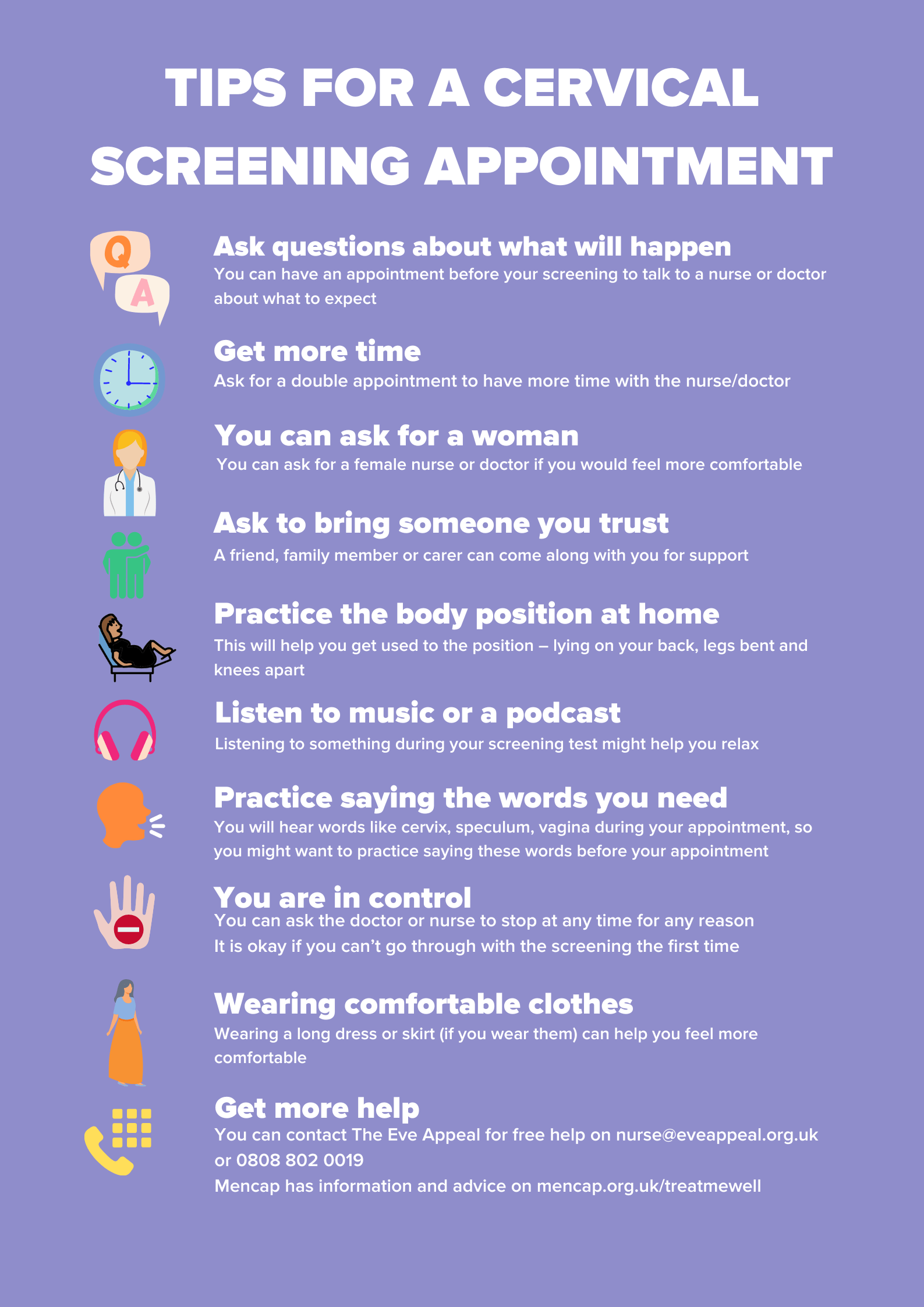
Cervical screening may be difficult for you if you have trauma that may be triggered. There are some things which you can do which may help make the experience a bit easier.
If you need any more support, do get in touch with our Ask Eve nurses who can help with advice and information on nurse@eveappeal.org.uk or 0808 802 0019. The Survivor’s Trust also has a support line on 0808 801 0818.
I have a learning disability and I’m worried about going for cervical screening.
We know that going for cervical screening may be scary, we have some Easy Read information on the test and tips to make the appointment easier which you can find here.
I have vaginal atrophy and am worried about going for my cervical screening test.
Vaginal atrophy is when the walls of the vagina have become thinner, dry and inflamed from a lack of oestrogen. It can affect people at any age but is most common after the menopause. Vaginal atrophy can be treated with over-the-counter vaginal lubricants, moisturisers (different from a lubricant) and for some women, doctors may prescribe an oestrogen based cream that can be applied directly to the affected area.
When going for a cervical screening test using the smallest speculum size suitable for you will help minimise any discomfort. Talk to the doctor or nurse before your test about any worries and explain that you have vaginal atrophy and will need the smaller speculum.
I have Lichen Sclerosus, what does this mean for me in terms of cervical screening?
Lichen Sclerosus is a chronic inflammatory skin condition that can affect any part of the body but is most commonly on the genitals. For some, lichen sclerosus won’t cause any issues when going for cervical screening, but for others the scar tissue that can form around the vulva and vaginal opening can cause pain and difficulty inserting a speculum. Applying vaginal moisturisers for 3 weeks before your appointment and using the smallest speculum suitable for you can be helpful and try to book a double appointment to talk through your needs, risks and options.
If you have questions about what might happen next with the results from your cervical screen, check out our answers to your questions about cervical precancerous treatment.
If you have any more questions or concerns about cervical screening, you can chat to our Ask Eve nurses for free and confidential advice or information by emailing nurse@eveappeal.org.uk, calling 0808 802 0019, or filling in the online contact form.