
Everyone has BRCA1 and BRCA2 genes. They are tumour suppressor genes and they play a role in protecting us from cancer. They help prevent the cells in our bodies from growing and dividing out of control. If there is a significant change (called an alteration or mutation) in either of the BRCA1 or BRCA2 genes, they may lose the ability to protect us from developing breast; ovarian; pancreatic and prostate cancers.
What is the risk a BRCA gene alteration will result in cancer developing?
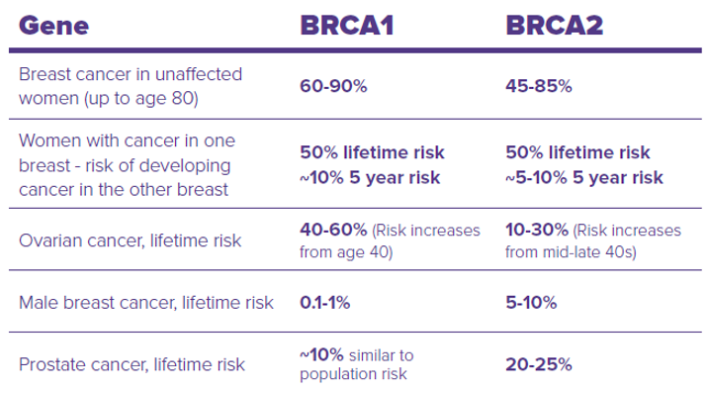
*Estimated lifetime risk (up to age 70) for people with BRCA1/2 alterations (mutations). Source: Royal Marsden Beginner’s Guide to BRCA1 and BRCA2
How common are BRCA gene alterations?
Around 1 in every 200-300 people in the general population will have a BRCA gene alteration. In some populations, they are more frequent, people of Ashkenazi Jewish descent, for example, have around a 1 in 40 chance of carrying a BRCA gene alteration.
Why might someone decide to get BRCA gene alteration testing?
Finding out you have an increased risk of cancer can be a lot to process, but it does offer some opportunities to either prevent certain cancers from developing (through risk reducing surgery) or catching them at the earliest opportunity through symptoms awareness or surveillance, when they are easiest to treat. It can also open up treatment options if breast or ovarian cancer does develop, help inform other family members to enable them to get genetic testing, and help you make decisions if starting a family.
Who is eligible for BRCA testing?
You can be tested on the NHS for the BRCA gene alterations if you fit certain criteria. Essentially if you have a strong family history of breast / ovary / prostate cancers or a relative with a known BRCA gene alteration, you are likely to be eligible for testing.
If you live in England and Wales you will be eligible for testing if:
- You have a first or second-degree relative with a diagnosis of ovarian cancer (mother, sister, daughter, grandparent, aunt, niece, or half-sister from either their mum or dad’s side of the family)
- You have Jewish ancestry (at least one grandparent on either side of the family)
- You have a blood relative (any gender) who has been found to have a BRCA gene alteration
- You have been diagnosed with ovarian cancer
If you fulfil any of the above conditions, please see your doctor and ask for a referral to your regional genetics centre where you will see a genetics clinician or genetics counsellor who will go through your family history of cancer and determine your eligibility of testing on the NHS.
New research around BRCA alterations and genetic testing is coming out all the time, the information on this page was accurate at the date of publication (22.04.2024). We will be regularly updating this page as the landscape changes, your GP, genetics counsellor or oncologist will be able to help with the most up to date advice for your situation.